
Written by: Matt Beucler, CEO, Plura AI
Key Takeaways for Contact Center Leaders
-
Branded caller ID replaces generic or spam-labeled displays with verified business name, logo, and call reason through direct carrier partnerships and STIR/SHAKEN authentication.
-
Verified identity drives higher pickup rates, with 73 to 78% of consumers more likely to answer when name, logo, and call reason are displayed.3
-
Carrier-level verification reduces spam labeling and improves number reputation compared to legacy CNAM systems that offer no spam remediation.
-
Branded caller ID boosts agent productivity by increasing connection rates 25 to 40% and reducing call-opening friction through instant brand recognition.
-
Plura AI is the only FCC-licensed, carrier-owned platform that issues branded caller ID at origination while maintaining stateful cross-channel memory; see how carrier-level issuance works in a live demo.
CNAM vs Branded Caller ID for High-Volume Contact Centers
CNAM is a legacy database system built around landlines. When an outbound call is placed, the terminating carrier performs a database lookup and returns a name string of up to 15 characters on a best-effort basis. CNAM does not address spam labeling, is suppressed by some terminating carriers, and produces inconsistent results across toll-free and non-toll-free numbers. Database entries are frequently outdated or truncated, which makes legitimate high-volume outbound calls appear unprofessional or suspicious.
Branded caller ID operates through a different mechanism. It transmits rich call data, including company name, logo, and call reason, exclusively on authenticated calls via direct carrier partnerships and verification processes. Calls are authenticated with the STIR/SHAKEN framework using digital certificates, which enables carriers such as AT&T, Verizon, and T-Mobile to receive verified sender information and display it on supported devices.
|
Attribute |
CNAM |
Branded Caller ID |
Plura (Carrier-Owned) |
|---|---|---|---|
|
Carrier authentication |
Best-effort database lookup, no cryptographic verification |
STIR/SHAKEN digital certificate authentication via carrier partnerships |
Carrier-provisioned branded caller ID issued at origination on Plura’s own FCC-licensed carrier |
|
Spam remediation |
No effect on nuisance or spam labels |
Carrier-level verification reduces spam flags and improves number reputation |
|
|
Regulatory verification |
No STIR/SHAKEN integration, not reported to FCC Robocall Mitigation Database |
STIR/SHAKEN status reportable to FCC Robocall Mitigation Database |
STIR/SHAKEN authentication on every outbound call, real-time DNC scrubbing and TCPA compliance support enforced at origination |
|
Display content |
15-character name string, no logo or call reason |
Up to 32-character name, logo, and call reason across major U.S. carriers |
Business name, logo, and call reason issued directly through Plura’s FCC-licensed carrier, with stateful call context carried across voice, SMS, RCS, and webchat |
Pickup Rates: How Branded Caller ID Changes Answer Behavior
Understanding how branded caller ID works at the carrier level is only half of the equation. The other half is whether it changes consumer behavior. A July 2020 Pew Research Center survey of 10,211 U.S. adults found that 80% say they do not generally answer their cellphone when an unknown number calls. That baseline defines the problem every outbound contact center operates against.
Verified identity changes the outcome. A consumer survey cited in the FCC’s December 2025 proposed rule found that 73% of consumers will answer a call if the caller’s name is presented, 76% if the name and logo are presented, and 78% if the reason for the call is also presented. Enterprises deploying branded caller ID solutions have seen improvements in contact-center answer rates after implementing branded calling.
Branded calling achieves approximately four times higher answer rates on calls to mobile devices compared to unregistered calls. For high-volume outbound operations, that lift translates directly into agent talk time, pipeline velocity, and cost per connected call.
Plura compounds this lift by issuing branded caller ID at the carrier level and communicating with Apple’s iOS 26 call-screening layer. Calls that would otherwise be intercepted before ringing through can present a recognizable identity to the recipient.
Spam Labeling: Protecting Number Reputation at the Carrier Level
Higher pickup rates matter only if the call reaches the recipient in the first place. Spam labels are assigned by carrier analytics systems that evaluate calling patterns, complaint data, and behavioral signals in real time. Surveys of enterprise leaders have found that improper spam labels can cause lower contact rates with customers. The gap between actual exposure and detected exposure creates significant operational risk.
Branded calling enables carrier-level verification of legitimate enterprise calls, which results in fewer spam flags and improved telephone number reputation compared to CNAM, which does not address spam labeling at all.
STIR/SHAKEN is a mandated FCC protocol that requires U.S. voice service providers to verify caller ID information on outbound calls. Calls failing authentication or trust checks may be labeled “Potential Spam”, routed to voicemail, or blocked by carriers. Branded caller ID functions as an overlay on STIR/SHAKEN, adding business name, logo, and call reason to improve consumer trust without replacing the underlying authentication protocol.
Plura remediates spam labels at the carrier level because it owns the carrier. Most Twilio-based API resellers inherit Twilio’s caller-ID reputation rather than their own, which means spam remediation is reactive and post-hoc rather than structural.4
Agent Productivity and First-Call Resolution Gains
Eighty percent of unidentified calls go unanswered, which causes contact-center agents to spend time dialing into the void instead of engaging in productive conversations. Every unanswered call represents agent time consumed without output: dial attempt, ring time, voicemail drop, and disposition logging.
Branded caller ID improves agent productivity through two mechanisms.
-
Higher connection rates per dial. Organizations addressing number reputation issues have achieved answer-rate improvements, faster agent connections with customers, and improved outbound campaign ROI without increasing call volume.
-
Reduced call-opening friction. With branded caller ID, agents do not need to spend time explaining who is calling and why during the opening of calls, which results in greater call engagement and reduced wasted agent time.
Consumers are more likely to answer calls when they see a business’s name and call reason, and sectors such as healthcare, finance, and insurance see notable boosts in answer rates.
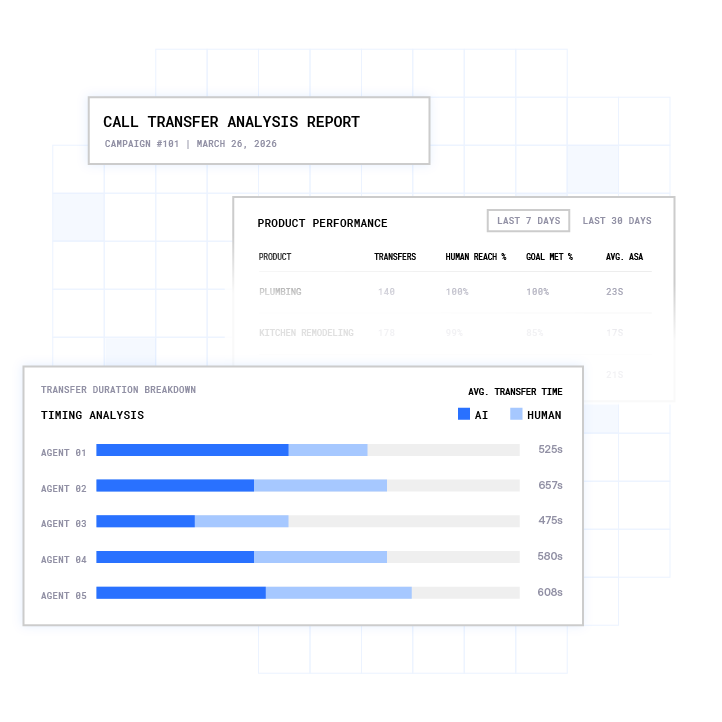
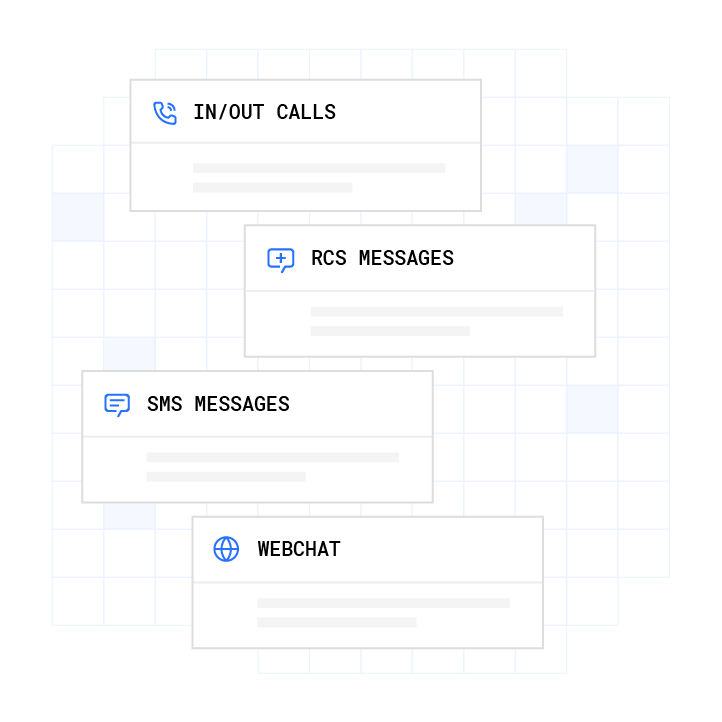
Plura adds a layer that third-party branded calling providers cannot replicate: stateful cross-channel memory. When an agent or AI that texted a lead at 9 a.m. picks up the call at noon, they already know what was said, what was offered, and what objections were raised because Plura’s Stateful Conversation Database carries that context across channels. This context eliminates re-qualification time and compresses handle time on every connected call.
See carrier-level branded caller ID and stateful memory in action in a live outbound workflow.
Regulatory Landscape and Verification Considerations
Branded caller ID intersects with several regulatory frameworks that contact center leaders should understand at a high level.2 Leaders should consult qualified counsel for guidance on their specific obligations.
The FCC Robocall Mitigation Database requires voice service providers and call centers to report their STIR/SHAKEN implementation status as part of federal robocall mitigation rules. In August 2025, 185 non-compliant providers were removed from the database, which prevented them from connecting to U.S. networks.
The FCC’s December 2025 proposed rule (FCC 25-76) would require terminating voice service providers to transmit verified caller name or other caller identity information to consumer handsets whenever they transmit an A-level STIR/SHAKEN attestation indicator, and would require originating providers to employ reasonable measures to verify the accuracy of business names, logos, and other non-number data. The FCC is also seeking comment on mandating Rich Call Data (RCD) to securely transmit verified caller identity information on IP networks. Operators should monitor FCC Docket No. 25-76 and consult counsel on how proposed rules may affect their outbound programs.
Florida S.B. 1516 and H.B. 1299, under consideration in the 2026 legislative session, would require telecommunications providers to authenticate caller ID information using STIR/SHAKEN protocols or comparable technology and block calls containing manipulated caller ID information, with an expected effective date of October 1, 2026 if enacted. State-level caller ID rules vary, so operators should review applicable state statutes with counsel.
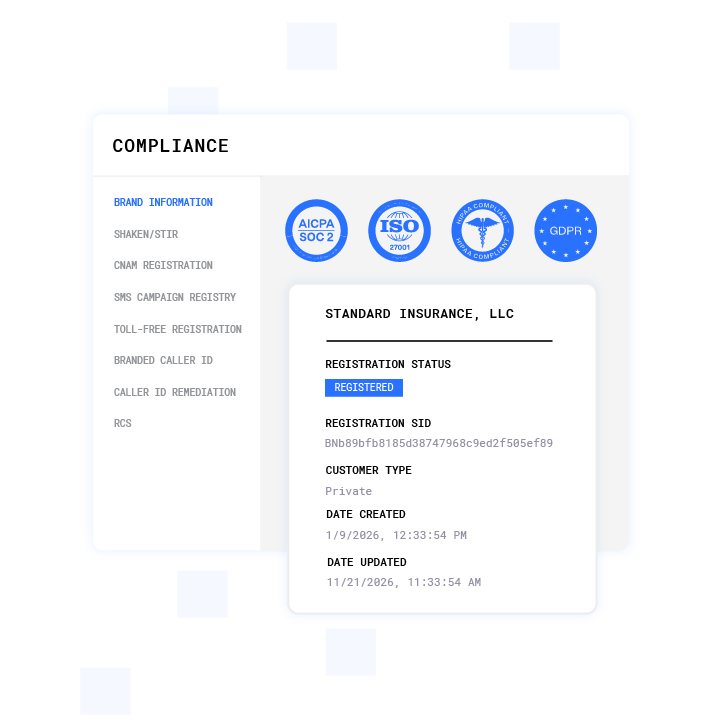
Plura supports compliance with STIR/SHAKEN caller ID verification, TCPA, DNC, SOC 2, HIPAA, ISO certification, and GDPR by enforcing compliance checks at the carrier level.1 Every outbound contact is checked against federal and state DNC registries in real time before dial, consent records are timestamped and immutable, and quiet-hours rules enforce automatically through time-zone detection. Plura provides the infrastructure and enforcement mechanisms, and customers remain responsible for their own regulatory obligations, certifications, and the claims they make to their end users.
Cost and ROI of Branded Caller ID for Contact Centers
The cost of branded caller ID depends on the delivery model. Third-party resellers typically charge on a per-call basis with volume discounts, and their pricing reflects the markup on carrier access they do not own. Twilio-based API resellers pass through a CPaaS wrapper tax in higher per-minute rates, slower onboarding, and a compliance posture that lives outside the platform.
Plura’s cost structure is different because the infrastructure is different. Plura owns its FCC-licensed audio bridging carrier, so voice originates on Plura’s domestic infrastructure rather than a third-party CPaaS. That ownership yields lower per-minute economics, direct issuance of branded caller ID, and compliance supported at the carrier level rather than bolted on after the fact.
The ROI case for carrier-level branded caller ID runs through agent occupancy. A 25% lift in answer rates on a 15-agent outbound team at 40% talk utilization does not require adding headcount. It reallocates existing capacity from unanswered dials to productive conversations.
Organizations deploying AI for speed to lead see connection rates increase by three to five times. At Plura’s published economics, six AI agents replace 15 human agents at $14,400 per month versus $60,000 per month, which generates $45,600 in savings in the first 30 days and $547,200 over 12 months.
Because Plura owns its carrier infrastructure, the only platform with this architecture, a branded caller ID is issued at origination and shares a Stateful Conversation Database across voice, SMS, RCS, and webchat. That combination is not available from any Twilio-based API reseller, any third-party branded calling provider, or any offshore BPO.
Run your numbers through Plura’s ROI calculator to check your contact-center economics in real time.
Conclusion: Carrier Ownership as the Differentiator
The data on branded caller ID is consistent across sources. Enterprises see improved answer-rate lifts, FCC survey data showing up to 78% answer rates with full branding, and the answer-rate improvements documented earlier for organizations that address number reputation. Legacy CNAM delivers none of these outcomes because it does not operate at the carrier level and has no mechanism for spam remediation.
The structural difference is carrier ownership. Plura issues branded caller ID directly through its FCC-licensed carrier, enforces STIR/SHAKEN authentication on every outbound call, scrubs every contact against DNC registries in real time, and carries conversation context across voice, SMS, RCS, and webchat in a single Stateful Conversation Database. No third-party reseller, Twilio-based API wrapper, or offshore BPO can replicate that stack.
Contact center leaders evaluating branded caller ID face a clear choice. The decision is not whether to implement branded caller ID, but whether the platform issuing it owns the carrier or rents it.
See all three capabilities running together on a single platform.
Frequently Asked Questions
Does branded caller ID work on all mobile devices and carriers?
Branded caller ID reaches the majority of U.S. mobile devices through direct carrier partnerships with Verizon, AT&T, T-Mobile, and others. Coverage extends to many U.S. mobile devices on supported networks. Logo display may be limited to specific devices or operating systems, particularly Android. Recipients do not need a special app or settings change, because the branded details are delivered via a data signal automatically on supported devices. Coverage gaps exist on older devices and some regional carriers. Plura’s carrier-level issuance maximizes reach because the branding originates on Plura’s own FCC-licensed infrastructure rather than passing through a third-party CPaaS that may have narrower carrier agreements.
Can branded caller ID be implemented without replacing an existing dialer or contact center platform?
In most cases, branded caller ID can be layered onto existing outbound infrastructure through API or SIP integration with a branded calling provider. The implementation process typically involves registering and verifying business identity, uploading branding assets, and completing carrier vetting. Many deployments go live within days to a few weeks depending on the provider’s verification workflow. Plura’s approach is different. Because Plura owns the carrier stack, branded caller ID is issued at origination rather than appended through a third-party integration. Operators who move to Plura replace their dialer, compliance bolt-on, and branded calling provider with a single platform that handles all four channels on one stateful database.
What is the relationship between STIR/SHAKEN and branded caller ID?
STIR/SHAKEN is a call authentication framework that cryptographically verifies the originating number of an outbound call and assigns an attestation level (A, B, or C) based on how completely the originating provider can verify the caller’s identity. Branded caller ID operates as an overlay on top of STIR/SHAKEN. The authentication layer confirms the call is legitimate, and the branded calling layer adds business name, logo, and call reason to the verified call. A call can carry STIR/SHAKEN authentication without branded caller ID, but branded caller ID without STIR/SHAKEN authentication is more vulnerable to spoofing and less likely to display consistently across carrier networks. Plura runs STIR/SHAKEN authentication on every outbound call through its FCC-licensed carrier, so branded caller ID is issued on a fully authenticated call rather than a third-party-routed one.
How does Plura handle spam label remediation differently from other platforms?
Most platforms address spam labels reactively by rotating DIDs, submitting remediation requests to carrier analytics providers, or monitoring number reputation through third-party tools. These approaches treat spam labeling as a reputation problem to be managed after the fact. Plura addresses it structurally. Because Plura is its own FCC-licensed carrier, branded caller ID is issued at origination with STIR/SHAKEN authentication on every call. Calls present with the company’s verified name and call reason rather than an unfamiliar number, which reduces the behavioral signals that carrier analytics systems use to assign spam labels in the first place. Plura also communicates with Apple’s iOS 26 call-screening layer, which converts calls that would otherwise be intercepted into answered calls. Twilio-based API resellers cannot replicate this because they inherit the caller-ID reputation of the CPaaS they rent from rather than operating their own carrier identity.
What compliance frameworks does Plura support for outbound branded calling?
Plura supports compliance with STIR/SHAKEN caller ID verification, TCPA, DNC, SOC 2, HIPAA, ISO certification, and GDPR. Every outbound contact is checked against federal and state DNC registries in real time before dial, consent records are timestamped and immutable, and quiet-hours rules enforce automatically through time-zone detection. The compliance dashboard exports audit-ready reports in one click. Plura provides the infrastructure and enforcement mechanisms, and customers are responsible for their own regulatory obligations, certifications, and the claims they make to their end users. Operators in regulated industries should consult qualified counsel on how TCPA, HIPAA, state mini-TCPA statutes, and evolving FCC caller ID rules apply to their specific outbound programs.
1 Plura AI maintains SOC 2, HIPAA, ISO, and GDPR posture as part of its platform infrastructure. References to compliance frameworks in this article describe Plura’s platform capabilities and do not constitute a guarantee that any customer using Plura will themselves be compliant with applicable laws or standards. Customers remain solely responsible for their own regulatory obligations, certifications, consent management, recordkeeping, and the claims they make to their own end users. Consult qualified legal counsel for guidance specific to your use case.
2 This article describes regulatory frameworks at a general level and does not constitute legal advice. Laws and regulations vary by jurisdiction, change over time, and apply differently depending on facts and circumstances. Readers should consult qualified legal counsel before making compliance decisions.
3 Performance figures, customer outcomes, and industry statistics referenced in this article are drawn from cited third-party sources or Plura customer case studies. Individual results vary based on implementation, use case, industry, audience, and execution. Past or aggregate performance is not a guarantee of future results.
4 References to third-party products, services, companies, or research are made for informational and comparative purposes only. Plura AI is not affiliated with, endorsed by, or sponsored by any third party named in this article unless explicitly stated. Trademarks and product names referenced remain the property of their respective owners.
This article is provided for informational purposes only and reflects Plura AI’s understanding at the time of publication. Product capabilities, integrations, and specifications are subject to change. For the most current information, visit plura.ai.
This article was produced with the assistance of AI tools and reviewed by Plura AI prior to publication.